 |
| Ancient Library of Alexxandria |
The loss of the ancient world's single greatest archive of knowledge, the Library of Alexandria, has been mourned for ages. But how and why it was lost is still a mystery. There have been many stories and arguments surrounding who was responsible for its destruction and I will take a look at each “suspect”, so you can make up your own mind.
Alexander the Great’s successor as Pharaoh, Ptolomy II Soter, founded the Museum or Royal Library of Alexandria in 283 B.C. The Museum, which was located in the Bruchion or palace quarter of the city of Alexandria, was a place of study, which included lecture areas, gardens, and even a zoo. Over 100 scholars lived at the Museum full time to perform research, write, lecture or translate and copy documents. The Great or more properly Royal Library formed a part of the Museum but whether or not it was a separate building is unclear. It has been estimated that at one time the Library of Alexandria held over half a million documents from Assyria, Greece, Persia, Egypt, India and many other nations. The library was so large it actually had another branch or "daughter" library established at the Temple of Serapis, known as the Serapeum, in approx. 235 B.C. Stories about its demise have been circulating for centuries and date back to at least the first century AD.
The first, and perhaps most known story, is one that lays the responsibility for the Great Library’s destruction upon Julius Caesar. When Julius Caesar came to the aid of Cleopatra in her war against Ptolemy XIII in 48 B.C., he burned the ships in Alexandria’s harbor to prevent his enemy from taking the city by sea. The fire spread to the docks, then to the districts of the city, where the Royal Library stood. According to Roman Philosopher, Seneca, some 40,000 scrolls where lost in the destructive fire, while other authorities state that the only dockside storage and the books contained within were destroyed. Whatever the case, considering the library held between 400,000 to 700,000 scrolls, a loss of 40,000 scrolls does not account for the loss of the entire institution. Also, given the fact that the Royal Library was housed in two separate places in different parts of the city (the Library that formed part of the museum, on the palace grounds; and the “daughter” library in the Temple of Serapis), it seems unlikely that one fire (unless it was to engulf the entire city) could destroy the entire collection. Visitors to Alexandria in the period after his death leave evidence of great libraries’ continued existence. So, if this is true, Caesar was not to blame for the destruction of the Great Library of Alexandria, although it seems clear that his actions may have damaged or destroyed some of its holdings.
Chronologically, the next story of the destruction of the Great Library recounts its destruction during the Emperor Aurelian’s taking of Alexandria in 272 A.D. Aurelian’s troops met heavy resistance in the fight for the city, and the area in which the museum was located was badly damaged. One report by Ammianus Marcellinus recounts that the district was razed to the ground, and one scholar, at least, is convinced that this is the event that destroyed the entirety of the Great Library. The smaller library located at the Temple of Serapsis survived, but part of its contents may have been taken to Constantinople to adorn the new capital in the course of the 4th century.
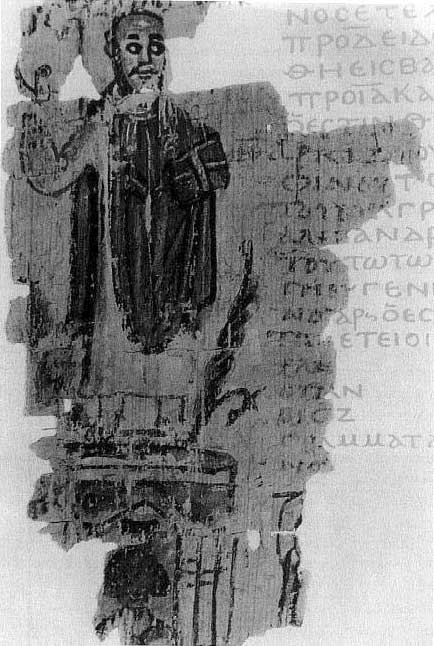 |
| 5th century scroll which illustrates the destruction of the Serapeum by Theophilus. |
Another story of the Great Library’s destruction says that it was destroyed by religious riots in 391 A.D. By this time, Christianity has been declared the official religion of the Roman Empire and Emperor Theophilus sanctioned the destruction of all pagan temples in Alexandria. As the “daughter” library at the Temple of Serapsis, the Serapeum, was itself a pagan temple, Theophilus lead a mob to the entrance where, reputedly, he struck the first blow against the temple. His frenzied cohorts followed suit, eventually demolishing the entire Temple of Serapis. When the devastation of the temple was complete, Theophilus ordered a church to be built on the site of the ruins. It seems safe to assume that the collection of books housed within the Temple of Serapis would have met largely the same fate as the temple itself, though there is some debate among scholars as to whether this is entirely accurate. However, given that Theophilus’ crusade was not only against pagan temples, but also against pagan learning and ideas, it seems inevitable that the Library collection, as well as the storehouses and other institutions associated with it would have been destroyed. While this story accounts for the destruction of the “daughter” library by Theophilus, the fate of the Royal Library collection is unclear.
It seems that whatever previous events may have occurred, there may have been some remnants of the Great Library’s collection left in Alexandria at the time of the Arab conquest. At the very least there is one story that lays the blame for the Royal Library’s destruction on Caliph Omar during the Arabic conquest of Egypt in 639 A.D. Caliph Omar reputedly instructed that all the books in the Royal Library, save for the works of Aristotle, be destroyed. For, “if what is written in them agrees with the book of God, they are not required; if it disagrees, they are not desired. Destroy them therefore.” General Amr followed his orders and reputedly took the books to the bathhouses of Alexandria to be used as fuel for heating the water, where it is said that it took six months to burn them all. But these details, including the far-fetched statement that it took six months to supposedly burn all the books, weren't written down until 300 years later, and were written by Bishop Gregory Bar Hebræus, a Christian who spent a great deal of time writing about Moslem atrocities without much historical documentation.
So who did burn the Library of Alexandria?
Probably everyone mentioned above had some hand in destroying part of the library's holdings. But, the real tragedy is not the uncertainty of who to blame for the Library's destruction, but that so much ancient history, literature and learning was lost forever.
Notes:
This blog has not taken me as long as the last, due to finding some great reference sources. However, due to the nature of this subject, finding reliable information was very difficult, due to conflicting stories. The first place I sought information was from dictionaries, but neither Brittanica nor Oxford provided me with much, apart from background information. The best source of information was an e-journal found through the GALE database. I also used a couple of different books and websites for cross referencing.
References
'Alexandria, Library of', Encyclopædia Britannica, Encyclopædia Britannica Online, viewed 6 May, 2011.
'Alexandrian Library', The Concise Oxford Companion to Classical Literature, Oxford Reference Online, viewed 6 May, 2011.
'Alexandrian Library', The Concise Oxford Companion to Classical Literature, Oxford Reference Online, viewed 6 May, 2011.
'Ancient Libray of Alexandria' [image], Wikipedia Commons, viewed 11 May, 2011,
<http://upload.wikimedia.org/wikipedia/commons/6/64/Ancientlibraryalex.jpg>
Battles, M 2004, Library: an unquiet history, W. W. Norton, New York.
Chesser, P 2002, The Burning of the Library of Alexandria, e-History Library, viewed 6 May 2011, <http://ehistory.osu.edu/world/articles/ArticleView.cfm?AID=9>
Phillips, H 2010, 'The Great Library of Alexandria', Library Philosophy and Practice, vol. 12, issue 2,
General OneFile, Gale, viewed 6 May, 2011.
'Theophilus' [image], Wikipedia Commons, viewed 11 May, 2011,
Fishburn, M 2008, Burning Books, Palgrave Macmillan, New York.
Hannam, J 2003, The Mysterious Fate of the Great Library of Alexandria, Bede’s Library, viewed 6 May 2011, <http://www.bede.org.uk/library.htm>
Hannam, J 2003, The Mysterious Fate of the Great Library of Alexandria, Bede’s Library, viewed 6 May 2011, <http://www.bede.org.uk/library.htm>
Phillips, H 2010, 'The Great Library of Alexandria', Library Philosophy and Practice, vol. 12, issue 2,
General OneFile, Gale, viewed 6 May, 2011.
'Theophilus' [image], Wikipedia Commons, viewed 11 May, 2011,
<http://upload.wikimedia.org/wikipedia/commons/3/34/Theophil.jpg>
ulver22 2007, Carl Sagan introduces the library of Alexandria, 20 January, viewed 11 May, 20011, <http://www.youtube.com/watch?v=OLlVnKOb4Mk>
ulver22 2007, Carl Sagan introduces the library of Alexandria, 20 January, viewed 11 May, 20011, <http://www.youtube.com/watch?v=OLlVnKOb4Mk>

No comments:
Post a Comment