 |
| Qin emperor, Qin Shi Huang |
In third century B.C. China, Qin emperor Qin Shi Huang undertook perhaps the most extensive book burning the world has ever known. His aim was to destroy all Chinese literature, all history and all philosophy written before his dynasty.
According to the Records of the Grand Historian, after Qin Shi Huang unified China in 221 BC, his chancellor Li Si – whose Legalist scholarship was snubbed by Confucians – suggested suppressing the freedom of speech, unifying all thoughts and political opinions. As the Records of the Grand Historian tells it, Li Si pressed his case:
In the past the empire was fragmented and in confusion and no one was able to unite it. Therefore the feudal rulers rose up side by side, all of them declaiming on antiquity in order to disparage the present, parading empty words in order to confuse the facts. Men prided themselves on their private theories and criticized the measures adopted by their superiors… I therefore request that all records of historians other than those of the state of Qin be burned.
The emperor agreed wholeheartedly and an imperial decree granted approval of the proposal. So to avoid any comparisons of his reign with the past, beginning in 213 B.C., Qin Shi Huang ordered most existing books to be burned, with the exception of those on astrology, agriculture, medicine, divination, and the history of the State of Qin. The books would have burned well, even though paper was not invented in China until the second century A.D. While silk was often used as a writing medium, books in ancient China were typically made of strips of bamboo, sewn together like venetian blinds, with each strip containing a single row of characters, read vertically.
Classic works, including the Book of Songs (or the Classic of Poetry; a collection of Chinese poems and songs); the Classic of History (a compilation of records of events in ancient China history); and works by scholars of different schools, were to be handed into the local authorities for burning; and anyone discussing these two particular books be executed. Also, any authorities who failed to report cases that came to their attention were equally guilty; and those who had not burned the listed books within 30 days of the decree were to be banished to the north as convicts to work on building the Great Wall.
According to the later Records of the Grand Historian, the following year Qin Shi Huang ordered a roundup of independent “masters”, a term that referred to classical scholars. More than 460 were executed, although a later account in the second century added another 700 to the figure. The word used in the records, keng, is usually translated as “executed”, though it literally means “buried alive”. The term for the event would knwn by generations of Confucian scholars as the fengshu kengru, the burning of books and burial of scholars.
The ban on books was lifted in 191 BC, after the Qin were overthrown by the Han Dynasty. Fragments of the old records were found and history reconstructed, but despite the value placed on classical learning, threats to books and scholars persisted. In response to such threats, scholars sought a medium more permanent than the bamboo strips and began using stone. According to legend, the new Emperor ordered that the Five Confucian Classics should be carved in their entirety on huge tablets of non-flammable stone, but mobs infuriated by the cost of the project smashed them into fragments
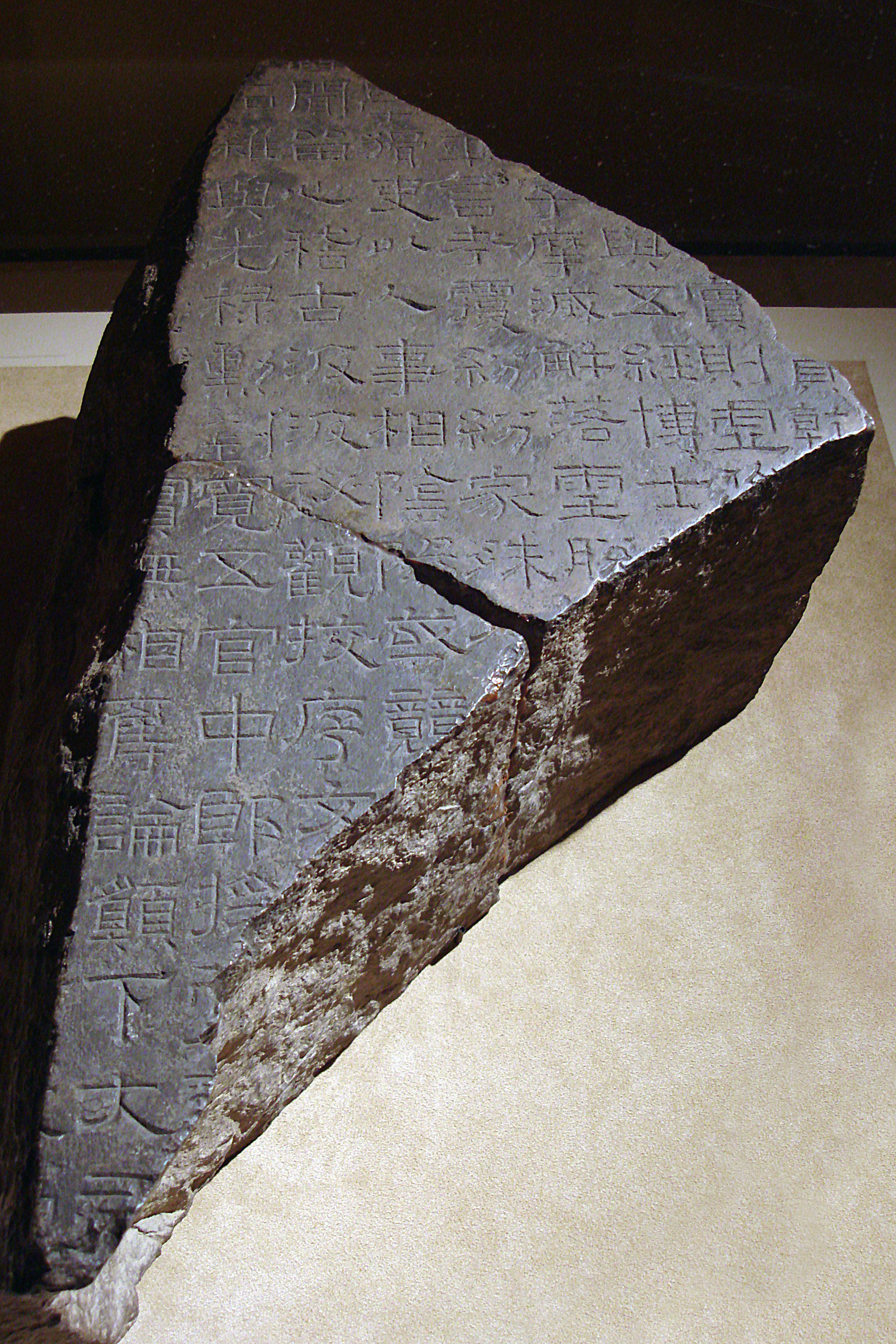 |
| A fragment of one of the 'Stone Classics' |
Damage to Chinese culture was compounded during the Cultural Revolution (from 1966 through to 1976), where countless books were destroyed; along with paintings, artifacts, antiques and buildings. Books were major targets of Mao's order to destroy, because they had not been written within the last few months, and therefore did not quote Mao on every page.
Notes:
Well, it is finally here - my second blog post. After blogger decided to corrupt my last draft, this one is now up for you all to read and hopefully enjoy. Luckily I had kept all my research notes, so it hasn't taken me too long to redo. So, regarding research, I started first with a book I borrowed from the Swinburne Library called Library: An unquiet history, written by Matthew Battles. This was an excellent resource, with a lot of useful information. I also used GALE database, through Swinburne Library and managed to find a few interesting articles. Other resources used, include general websites and Enyclopedia Britannica Online. Hopefully my next blog shouldn't take as long to complete, see you then.
References
Battles, M 2004, Library: an unquiet history, W. W. Norton, New York.
Brand, Stewart, 'Burning Libraries', Whole Earth Winter 1999, vol. 56, General OneFile, Gale, viewed 4 May, 2011.
'burning of the books', Encyclopædia Britannica, Encyclopædia Britannica Online, viewed 5 May, 2011.
'CMOC Treasures of Ancient China exhibit' [image], Wikipedia Commons, viewed 5 May, 2011,
Koeller, DW 1999, The Burning of the Books, The Web Chronology Project, viewed 1 May, 2011,
Marking, S 2002, 'The House of Burned Books', Index on Censorship, vol. 31, no. 4, General OneFile, Gale, viewed 4 May, 2011.
'Qin Shi Huang' [image], Wikipedia Commons, viewed 5 May, 2011,


No comments:
Post a Comment